
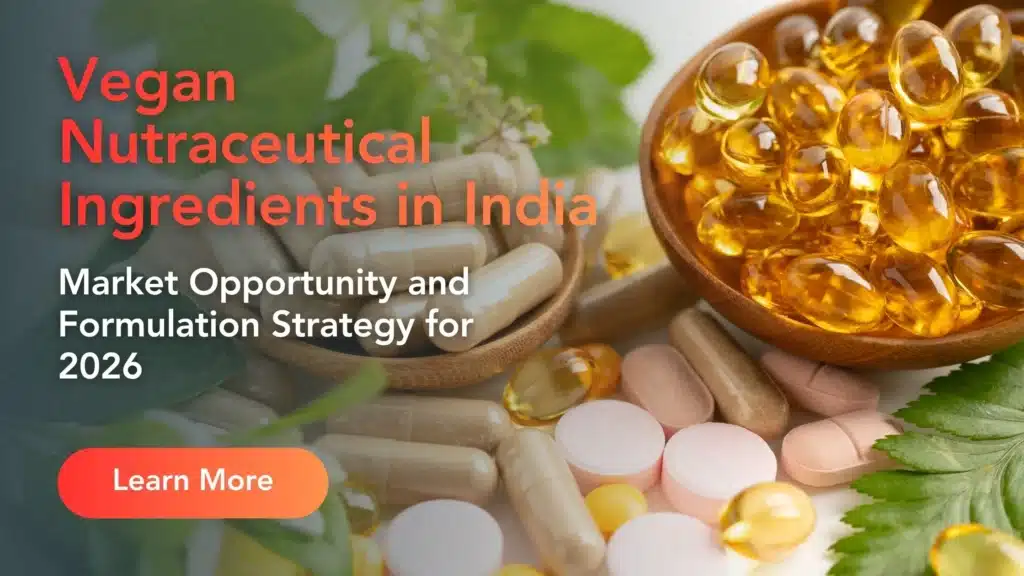
India’s demand for vegan nutraceutical ingredients is accelerating faster than the supply chain can reliably service it. Consumer preference for plant-based, clean-label supplements is no longer a niche — it is a mainstream procurement priority, particularly in urban markets and among the Gen Z demographic now entering peak supplement-buying years.
The opportunity is real. So is the complexity. Not everything labelled ‘vegan’ or ‘plant-based’ is genuinely derived from plant sources. Synthetic alternatives exist across nearly every ingredient category — technically meeting the definition of ‘no animal derivatives’ while lacking the traceability, clinical validation, and label storytelling value of truly plant-origin ingredients.
For supplement brands, formulators, and procurement heads: the distinction between genuinely plant-derived and technically vegan is becoming a brand-defining decision. This guide covers the market signals, the most in-demand ingredient categories, the formulation challenges unique to plant-based sourcing, and what separates credible vegan nutraceutical ingredient suppliers from the rest.
Why Vegan Nutraceutical Ingredients Are No Longer a Niche Play
India’s nutraceutical market — valued at approximately USD 35 billion domestically by some estimates and growing at nearly 20% CAGR — is being reshaped by three intersecting forces that are making vegan nutraceutical ingredients a commercial imperative rather than an ethical preference.
Consumer Demand: Urban India and the Gen Z Effect
India’s deeply rooted vegetarian heritage, combined with the rapid rise of veganism and clean-label consciousness among younger urban consumers, is creating sustained demand for supplements that can genuinely claim plant-origin sourcing. Gen Z consumers — spending upwards of 7 hours daily on screens and actively researching supplement ingredients — are not satisfied with ‘vegetarian-friendly’ labels that obscure animal-derived actives.
Regulatory Direction: FSSAI’s Clean-Label Push
FSSAI’s 2025-26 regulatory evolution is tightening requirements around ingredient sourcing documentation and label claim substantiation. Brands carrying plant-based claims backed by undocumented or ambiguously sourced ingredients face increasing compliance exposure. The regulatory trend is unambiguous: transparency is being enforced, not just encouraged.
Export Market Pressure
Indian supplement brands expanding into European, Middle Eastern, and Southeast Asian markets encounter vegan and halal certification requirements that go beyond FSSAI compliance. Ingredients certified by the Vegan Society, carrying Halal and Kosher documentation, and produced under traceable supply chains unlock export markets that animal-derived or synthetic alternatives cannot access without additional compliance burden.
Vitafoods India 2026 confirmed the direction: clean-label ingredients, science-backed formulations, and plant-based sourcing dominated the exhibition floor conversations. The market signal is clear.
The Most In-Demand Vegan Nutraceutical Ingredients for Indian Formulators
Four categories are driving the highest volume of B2B inquiry and formulation interest heading into 2026:
1. Vegan Vitamin D3 — The Label Integrity Solution
Conventional Vitamin D3 (cholecalciferol) is derived from lanolin — a grease extracted from sheep’s wool. In India, it is sometimes labelled ‘vegetarian-friendly’ because the wool extraction process does not require slaughter. It is not plant-derived. Lichen-derived Vitamin D3 — sourced from a plant organism — is chemically identical to lanolin-derived D3, but genuinely plant-origin.
For brands claiming ‘100% plant-based’ or ‘vegan-certified,’ lichen-derived D3 is the only D3 that supports those claims without asterisks. It carries Vegan Society registration, FSSAI approval, India green dot certification, and clears Halal and Kosher requirements. India’s plant-based D3 market is growing at 5.8% CAGR, with demand concentrated in urban immunity, bone health, and lifestyle supplement formats.
2. Plant-Based Collagen Alternative — The Beauty-From-Within Opportunity
Collagen is one of the fastest-growing supplement categories globally and in India. The conventional sources — bovine, porcine, and marine collagen — carry animal welfare concerns, BSE risks, and supply volatility. They also represent only one of the 28 types of human collagen.
The plant-origin alternative is a fermentation-derived collagen amino acid complex — 18 amino acids in the same proportions found in human collagen, produced from non-GMO plant inputs under controlled fermentation. This approach addresses all 28 human collagen types, delivers pre-isolated amino acids that do not require digestive breakdown, and eliminates the contamination and batch-variability risks inherent in animal tissue processing. For Indian brands targeting skin, hair, nail, and joint health markets, this is the formulation-forward choice.
3. Brain Health Magnesium — The Cognitive Health Play
Not all magnesium supplements support cognitive function. Most common magnesium forms — oxide, citrate, glycinate — do not effectively cross the blood-brain barrier. A patented magnesium form developed specifically to increase brain magnesium levels has published double-blind, placebo-controlled clinical studies demonstrating improvements in working memory, attention, and sleep quality.
This is the ingredient driving the nootropics and digital wellness supplement categories — targeting the Gen Z demographic experiencing documented digital fatigue. The clinical specificity of its mechanism (blood-brain barrier crossing) provides a formulation narrative that ‘contains magnesium’ cannot match.
4. Plant-Derived Joint Health Ingredients — The Active Ageing Market
Traditional chondroitin is sourced from shark cartilage or bovine tissue — raising sustainability, BSE, and labelling concerns. Plant-derived alternatives sourced from seaweed provide a mucopolysaccharide structure similar to animal chondroitin, carrying Vegan Society and Vegetarian Society registration. As India’s active ageing population grows and sports nutrition brands seek clean-label joint health solutions, this category is seeing accelerating formulator interest.
| Ingredient | Conventional Source | Plant-Origin Alternative | Key Certifications |
| Vitamin D3 | Lanolin (sheep’s wool) | Lichen-derived cholecalciferol | Vegan Society, FSSAI, Halal, Kosher |
| Collagen | Bovine / porcine / marine tissue | Fermentation-derived amino acid complex | Vegan Society, non-GMO |
| Cognitive magnesium | Inorganic mineral forms | Patented organic compound (clinical studies) | GRAS, multiple market approvals |
| Chondroitin | Shark cartilage / bovine | Seaweed extract | Vegan Society, Vegetarian Society |
The Formulation Challenges Unique to Vegan Ingredients
Sourcing genuinely plant-derived ingredients introduces specific challenges that brands and formulators need to anticipate:
- Verification burden: The onus of confirming genuine plant-origin sourcing falls on the brand. Supplier claims must be backed by Certificates of Analysis, sourcing declarations, and third-party certifications — not just product data sheets.
- Synthetic vs. plant-derived ambiguity: Synthetic ‘vegan’ ingredients — produced in laboratories without animal inputs — are technically vegan but lack the sourcing story, co-factors, and consumer resonance of genuinely plant-derived alternatives. Brands building a clean-label narrative need to understand this distinction before sourcing.
- Batch consistency in fermentation-derived ingredients: Fermentation processes require rigorous quality management to maintain consistent amino acid ratios and potency across batches. Suppliers with robust GMP certification and documented batch records are essential.
- Cost vs. clinical backing: Patented plant-derived ingredients carry a price premium over commodity alternatives. The commercial case for that premium lies in the clinical studies, certifications, and formulation support they bring — factors that directly reduce R&D risk and regulatory exposure.
What Separates Serious Vegan Nutraceutical Ingredient Suppliers
As demand for vegan nutraceutical ingredients grows, the supplier landscape is becoming crowded with commodity alternatives and partially-documented options. The markers of a credible, long-term-capable supplier are specific:
- Independent multi-market certifications: Vegan Society, FSSAI, GRAS, Halal, Kosher — not just one, and not self-declared.
- Published clinical studies: Peer-reviewed, double-blind studies for key actives, not just in-vitro data or general category references.
- Full sourcing traceability: From plant source to delivery, with documentation available on request.
- Formulation technical support: Dosage recommendations, stability data, compatible ingredient guidance, application format knowledge.
- Regulatory documentation for export markets: Pre-prepared dossiers for FSSAI, Halal, and international regulatory requirements reduce brand-level compliance work.
Positioning Your Brand Around Vegan Ingredient Sourcing
The brands gaining market share in India’s premium supplement segment are not just selling plant-based — they are documenting it. Sourcing certifications, clinical study references, and supply chain origin stories are becoming marketing assets, not just compliance requirements.
The formulation decision and the brand story are now the same decision. An ingredient with Vegan Society registration, a published clinical study, and a traceable plant-origin source is not just compliant — it is differentiated. In a category where consumer trust is the primary commercial currency, that differentiation compounds over time.
| Key Takeaways: India’s vegan nutraceutical ingredient market is growing faster than supply can reliably service — first-mover brands will own the category.Not all ‘vegan’ ingredients are plant-derived. Synthetic alternatives exist across every category. The distinction matters for brand credibility.Four categories driving the highest formulator interest: lichen-derived Vitamin D3, fermentation-based collagen amino acid complexes, clinical-study-backed brain health magnesium, and seaweed-derived joint health ingredients.FSSAI’s regulatory tightening and export market requirements make multi-market certification a procurement necessity, not a premium option.Credible suppliers offer published clinical studies, full sourcing traceability, and multi-market certifications — not just product data sheets.The formulation decision and the brand story are now the same decision. Sourcing documentation is a marketing asset. |
FAQs: Vegan Nutraceutical Ingredients
| 1. What are vegan nutraceutical ingredients?Vegan nutraceutical ingredients are bioactive compounds used in supplement formulation that contain no animal-derived inputs — including in their sourcing, processing, or carrier systems. True plant-derived ingredients (from lichen, fermentation, or seaweed) differ from synthetic vegan alternatives: both are animal-free, but only plant-derived ingredients offer sourcing traceability and consumer-resonant origin stories. |
| 2. Is lanolin-derived Vitamin D3 considered vegan?No. Lanolin is sourced from sheep’s wool and is not plant-origin. In India, it is sometimes labelled ‘vegetarian-friendly’ because extraction does not require slaughter — but it does not meet vegan or genuinely plant-based standards. Lichen-derived Vitamin D3 (cholecalciferol) is the only form of D3 that is genuinely plant-origin and carries Vegan Society certification. |
| 3. What is the difference between plant-based collagen alternative and animal collagen?Animal collagen (bovine, marine, porcine) is extracted from connective tissue and represents one type of human collagen. Plant-derived collagen alternatives use fermentation to produce the 18 amino acids found in human collagen, addressing all 28 collagen types. The fermentation approach eliminates contamination risks, batch variability from seasonal factors, and animal welfare concerns. |
| 4. Which certifications confirm that an ingredient is genuinely vegan?The Vegan Society trademark is the global gold standard for vegan ingredient certification. In India, the FSSAI green dot (for vegetarian) and specific Vegan Society registration together confirm plant-origin sourcing. Halal and Kosher certifications provide additional documentation of non-animal sourcing, which matters for export markets. |
| 5. Why are patented vegan nutraceutical ingredients worth the price premium?Patented ingredients come with published clinical studies, consistent manufacturing specifications, and multi-market certifications that commodity alternatives cannot provide. For brands building credibility, pursuing export markets, or making specific health claims, the clinical and regulatory backing of a patented ingredient reduces formulation risk, R&D cycles, and regulatory exposure — typically at a net cost saving over time. |
| 6. Which vegan nutraceutical ingredients are seeing the fastest growth in India in 2026?Lichen-derived Vitamin D3, fermentation-produced collagen amino acid complexes, patented brain-health magnesium compounds, and plant-derived chondroitin alternatives are seeing the strongest B2B demand growth — driven by urban clean-label consumer trends, FSSAI compliance requirements, and Indian brands’ growing export ambitions. |
| Ready to formulate with genuinely plant-derived nutraceutical ingredients? Avlaan Pharmaceutical supplies certified vegan nutraceutical ingredients with published clinical backing, Vegan Society registration, and complete sourcing traceability — for Indian and export markets.→ Vitashine® / VegD3®: Lichen-derived Vitamin D3→ Vollagen®: Fermentation-derived collagen amino acid complex→ Magtein®: Patented brain health magnesium→ Phytodroitin™: Plant-derived joint health ingredient Contact: info@avlaanpharma.com | +91 9677 239 111 | avlaanpharma.com |
For more details visit : FSSAI