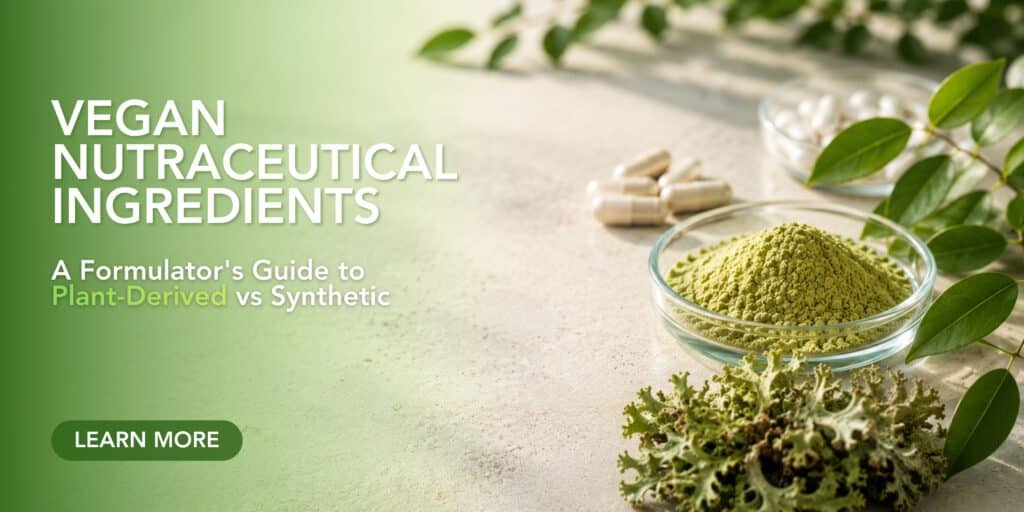
Your product says ‘vegan.’ Your ingredient deck may tell a different story.
Across India’s supplement market, vegan nutraceutical ingredients has become one of the most misused claims in formulation. Some ingredients marketed as vegan are genuinely plant-derived – extracted from botanical sources with verifiable origin and clean processing history. Others are synthetic alternatives that contain no animal material but are produced through industrial chemical synthesis with no plant origin whatsoever.
For formulators, this distinction is not semantic. It determines what your label can legitimately claim, which markets you can export to, and whether your product survives the ingredient transparency scrutiny that India’s supplement buyers now demand.
What ‘Vegan’ Actually Means for Nutraceutical Ingredients
Vegan, as defined by the Vegan Society – the global certification standard – means free from animal-derived materials at every stage of production. This includes raw material origin, processing aids, and encapsulation formats.
Crucially, the vegan definition does not require plant-derived origin. It only requires the absence of animal origin.
This is where the plant-derived vs synthetic distinction becomes commercially significant:
| Category | Example | Vegan Certified? | Plant-Derived? |
| Genuinely plant-derived | Lichen-derived Vitamin D3 | Yes | Yes |
| Fermentation-derived | Collagen amino acid complex (non-GMO corn) | Yes | Yes |
| Synthetic (no animal origin) | Synthetically produced Vitamin D3 | Technically yes | No |
| Animal-derived | Lanolin D3, bovine collagen, marine collagen | No | No |
A label claiming ‘vegan’ can be technically accurate for a synthetic ingredient. But a label claiming ‘plant-based’ or ‘plant-origin’ requires genuine botanical sourcing. This is the distinction most brands miss – and the one regulators and institutional buyers increasingly enforce when evaluating vegan nutraceutical ingredients.
The Three Categories of Vegan Nutraceutical Ingredients – And Why Each Matters Differently
Category 1: Genuinely Plant-Derived
These ingredients are extracted directly from plant sources and carry traceable botanical origin. The production chain begins with a named plant material and preserves that plant-origin identity throughout.
Examples of genuinely plant-derived ingredients:
- Lichen-derived Vitamin D3 – cholecalciferol sourced from Cladonia rangiferina lichen. Chemically identical to animal-derived D3; origin is the differentiator.
- Plant-based chondroitin – mucopolysaccharide structure sourced from seaweed rather than shark cartilage or bovine trachea.
- Fermentation-derived collagen amino acid complex – 18 amino acids produced via precision fermentation of non-GMO corn substrate, in identical proportions to human collagen.
These vegan nutraceutical ingredients support the strongest label claims and carry the cleanest certification pathway – Vegan Society registration, FSSAI approval, Halal, and Kosher simultaneously – because their origin is unambiguous.
Category 2: Fermentation-Derived
Precision fermentation has created a distinct category where microorganisms fed on plant-based substrates produce specific functional molecules. The output is genuinely plant-substrate-derived, and the production mechanism is biotechnological.
For the B2B supplement market, fermentation-derived ingredients – when produced from non-GMO plant feedstocks – meet clean label, vegan, and plant-based claim requirements. Batch-to-batch consistency is typically superior to purely extracted botanical alternatives, making them particularly valuable for premium formulations where efficacy consistency matters.
Category 3: Synthetic Alternatives Marketed as Vegan
These are lab-synthesised molecules with no plant origin. They are free from animal materials and can carry a vegan certification, but they cannot support plant-based or plant-derived label claims.
The risk for brands is concrete: a formula built on synthetic ‘vegan’ ingredients marketed as plant-based is a mislabeled product. As consumers increasingly use ingredient-scanning apps to verify sourcing claims, the gap between claim and reality is no longer theoretical – it is a measurable brand liability.
Why Indian Supplement Formulators Need This Distinction in 2026
India’s brands formulating with vegan nutraceutical ingredients are operating in a materially different environment than three years ago. Three forces are making the plant-derived vs synthetic distinction commercially urgent:
- Export market regulatory tightening. EU, UK, and US markets apply increasingly precise definitions to plant-based claims. An ingredient labeled ‘plant-derived’ in an Indian product that reaches a European retailer triggers documentation requirements that synthetic alternatives cannot satisfy.
- Consumer ingredient literacy. Urban Indian consumers – particularly the 25–40 demographic driving supplement category growth – are cross-referencing ingredient decks against third-party databases. ‘Lichen-derived Vitamin D3’ and ‘synthetic Vitamin D3’ are distinguishable to an informed consumer. One supports a premium positioning; the other undermines it.
- Institutional buyer requirements. Pharmacy chains, hospital networks, and D2C platforms are tightening supplier vetting criteria. Some now require origin documentation for every active ingredient – documentation that only genuinely plant-derived ingredients can provide.
How to Evaluate Vegan Nutraceutical Ingredients Before They Reach Your Formula
A five-point verification process distinguishes genuinely plant-derived ingredients from synthetic alternatives presented as vegan:
| Verification Step | What to Request | Red Flag |
| 1. Source documentation | Named botanical or substrate at raw material level | “Synthetic origin” or vague plant claim without species/substrate |
| 2. Third-party certification | Vegan Society registration for the specific ingredient | Facility-level only – not ingredient-specific |
| 3. CoA specificity | Source plant or substrate identified in certificate of analysis | CoA describes only the finished molecule |
| 4. Processing aid disclosure | Full list of processing aids used – not just actives | Refusal to disclose processing aids |
| 5. Export certification stack | Vegan + Halal + Kosher + FSSAI documentation | Partial certification with no explanation |
The Commercial Advantages of Formulating with Genuinely Plant-Derived Vegan Ingredients
A clean-label formulation strategy built on genuinely plant-derived vegan nutraceutical ingredients delivers specific, durable commercial advantages:
- Label claim defensibility. Claims backed by verified botanical origin and third-party certification are significantly harder for regulators, competitors, or consumers to challenge.
- Multi-market export readiness. Certification documentation for plant-derived ingredients satisfies FSSAI, EU, UK, and Middle Eastern market requirements simultaneously – eliminating the need for ingredient substitution at each market.
- Consumer story quality. ‘Derived from lichen’ or ‘produced via fermentation from non-GMO corn’ provides a specific, credible ingredient narrative. Synthetic alternatives provide none – and increasingly, consumers notice the absence.
- Supply chain resilience. Specialty plant-derived ingredients sourced from traceable suppliers provide better supply chain documentation than commodity synthetics sourced through opaque intermediary chains.
The formulation decision is rarely just about the ingredient itself. It is about the entire ecosystem of claims, certifications, and market positioning that each category of vegan nutraceutical ingredients enables or forecloses.
| Key Takeaways |
| “Vegan” does not mean plant-derived. Understanding the distinction is essential for defensible clean-label formulation in India and export markets. |
| Three categories of vegan nutraceutical ingredients exist: genuinely plant-derived, fermentation-derived, and synthetic – with very different label claim capabilities. |
| Export regulatory requirements, consumer ingredient literacy, and institutional buyer criteria are all pushing supplement brands toward documented plant-derived sourcing. |
| Five verification steps – source documentation, third-party certification, CoA specificity, processing aid disclosure, and export certification compatibility – reliably distinguish plant-derived from synthetic. |
| Clean-label formulas built on genuinely plant-derived vegan ingredients provide defensible claims, multi-market export readiness, and stronger consumer positioning. |
FAQs:
| 1. What is the difference between plant-derived and synthetic vegan nutraceutical ingredients? Plant-derived ingredients originate from botanical sources (plants, lichen, seaweed) or plant-substrate fermentation, with traceable origin documentation. Synthetic vegan ingredients contain no animal material but are produced through industrial chemical synthesis with no plant origin. Both can carry vegan certification, but only plant-derived ingredients support ‘plant-based’ or ‘plant-origin’ label claims. |
| 2. Can a synthetic ingredient be certified as vegan? Yes. Vegan certification requires the absence of animal-derived materials – it does not require plant-derived origin. A synthetically produced Vitamin D3, for example, can meet vegan certification criteria. However, it cannot support ‘plant-derived’, ‘plant-origin’, or ‘plant-based’ label claims, which are increasingly important for clean-label positioning and export market compliance. |
| 3. How do I verify that a vegan nutraceutical ingredient is genuinely plant-derived? Request source documentation naming the specific plant species or fermentation substrate, a certificate of analysis identifying origin at the raw material level, ingredient-specific Vegan Society registration (not just facility-level certification), and full processing aid disclosure. Suppliers of genuinely plant-derived ingredients can provide all of these; suppliers of synthetic alternatives typically cannot. |
| 4. Why are vegan nutraceutical ingredients important for export markets? EU, UK, and US markets apply precise regulatory definitions to plant-based claims. Brands using synthetic vegan ingredients while making plant-origin claims face labeling compliance risks in these markets. Genuinely plant-derived ingredients with the appropriate certification stack satisfy requirements across Indian (FSSAI) and international markets simultaneously. |
| 5. What are the best plant-derived vegan nutraceutical ingredients for supplement formulation in India?High-demand plant-derived ingredients for Indian supplement brands include lichen-derived Vitamin D3 (immunity and bone health), fermentation-derived collagen amino acid complexes (skin, hair, joint health), our patented and clinically studied ingredient Magtein® (Magnesium L-Threonate) for cognitive health, and plant-based chondroitin sourced from seaweed for joint health applications. |
| Get in Touch |
| Building a clean-label formula with verifiably plant-derived ingredients? Avlaan Pharmaceutical supplies genuinely plant-origin vegan nutraceutical ingredients – including lichen-derived Vitamin D3, fermentation-produced collagen amino acid complexes, our patented and clinically studied ingredient Magtein® (Magnesium L-Threonate), and plant-based chondroitin – with full certification documentation for Indian and export markets. Email: info@avlaanpharma.com | Phone: +91 9677 239 111Website: avlaanpharma.com |