In India, a green dot on a pack means vegetarian – it does not mean vegan. That distinction is about to carry legal weight, and brands building on vegan nutraceutical ingredients need to understand the gap before it costs them.
On 25 May 2026, FSSAI notified the Vegan Foods Amendment Regulations, making a standardised “VEGAN” logo mandatory on every approved vegan food package from 1 July 2027. From that date, a “plant-based” claim is only as defensible as the certification behind each of its vegan nutraceutical ingredients.
The risk is specific: one animal-derived active in an otherwise plant-based formula can break the whole claim. This guide covers how India defines vegan, the hidden ingredients that quietly violate it, and the certifications that make a formula built on vegan nutraceutical ingredients genuinely defensible.
“Vegetarian” and “Vegan” Are Two Different Claims
India already marks vegetarian and non-vegetarian foods with the familiar green and brown dots. Vegan is a separate, stricter standard – and now a separately regulated one.
The definition: under the FSS (Vegan Foods) Regulations, 2022, a food is vegan only if no ingredient – including additives, flavourings, enzymes, carriers, and processing aids – is of animal origin, and the product has involved no animal testing. A vegetarian product can still contain animal-derived inputs; a vegan one cannot.
The green dot, in other words, was never a vegan signal. From July 2027, only products approved against the vegan standard may carry the FSSAI vegan logo – so the claim becomes auditable rather than assumed.
The Hidden Animal-Origin Actives That Break a Vegan Claim
A formula can list mostly vegan nutraceutical ingredients and still fail on one overlooked input. Most accidental violations come from a handful of common actives whose default commercial source is animal-derived.
| Active | Common animal source | Plant-origin alternative |
|---|---|---|
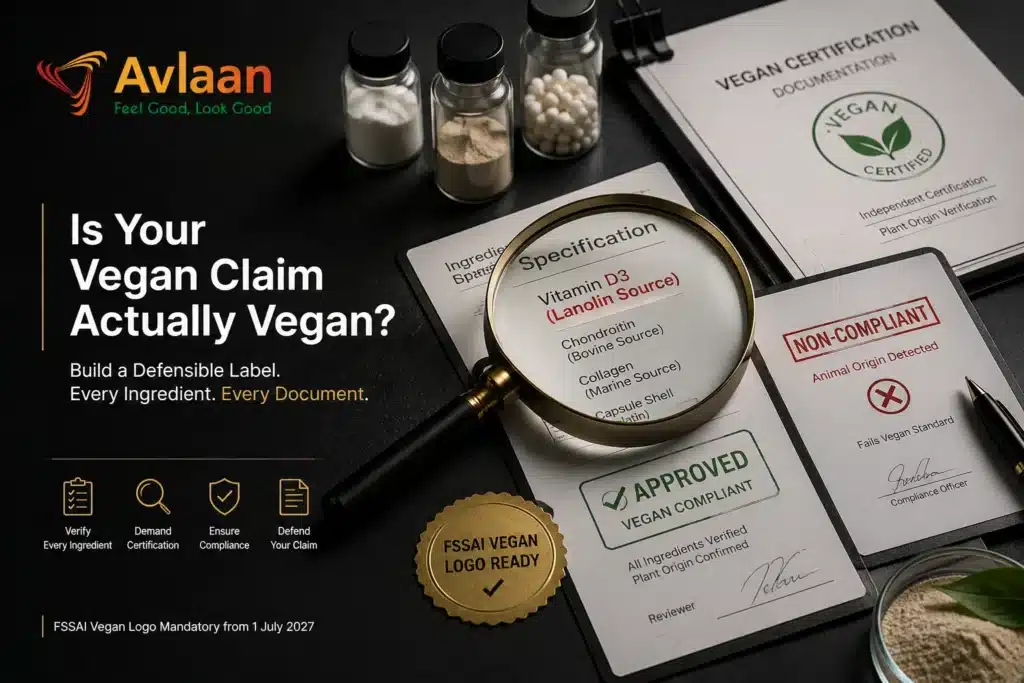
| Vitamin D3 (cholecalciferol) | Lanolin, from sheep’s wool | Lichen-derived D3 (Vitashine®) |
| Chondroitin | Shark or bovine cartilage | Algae-origin alternative (Phytodroitin™) |
| Collagen | Bovine, porcine, or marine tissue | Fermentation-derived amino acid complex (Vollagen®) |
| Capsule shell | Gelatin (animal) | Plant cellulose (e.g., HPMC) |
Vitamin D3 is the most common trap. Conventional D3 is extracted from lanolin – sheep’s wool grease – so a supplement can read “suitable for vegetarians” in some interpretations while failing any vegan standard outright.
Why “suitable for vegetarians” is not a defence
Vegetarian-suitable and vegan are not interchangeable. Lanolin-derived D3, animal gelatin capsules, and dairy-derived carriers can all sit inside a “vegetarian” product – and each one removes the right to a vegan claim.
This matters more in India than almost anywhere, because plant-based is now the dominant and fastest-growing source segment in the country’s nutraceutical market. The brands competing for that demand cannot afford a claim that unravels on inspection.
Where the animal inputs actually hide
The active is usually the obvious part. The violations tend to come from the supporting cast – the inputs a label rarely highlights:
- Carriers and diluents, such as lactose, a dairy-derived sugar used to standardise potency.
- Capsule shells made from gelatin rather than plant cellulose.
- Flow agents and excipients, where animal-derived stearates can appear.
- Flavour and colour systems that may carry animal-origin components or processing aids.
- Enzymes and processing aids used upstream, which the 2022 regulation explicitly counts.
None of these appears in a headline claim, yet any one of them can end it. A vegan audit follows the formula down to its smallest input – which is exactly why per-ingredient documentation matters more than a single front-of-pack line.
Certifications That Make a Vegan Claim Defensible
Certification is what turns vegan nutraceutical ingredients into a claim you can defend. A defensible vegan claim is built ingredient by ingredient, on documentation – not on the words “plant-based” alone.
- Independent vegan registration. Recognised certification (for example, Vegan Society registration) for each ingredient, not a supplier self-declaration.
- Per-ingredient proof. Certification covering the specific ingredient and grade you are buying, not the supplier’s product range in general.
- Batch-level assurance. Confirmation that the certified status applies to the lot supplied, not just to an approved sample.
- Non-GMO and source documentation. Clarity on the raw source and process – processing aids and carriers are exactly where animal inputs hide.
- FSSAI vegan-logo readiness. Documentation that will support FSSAI vegan-logo endorsement ahead of the 1 July 2027 deadline.
In short: a vegan label claim is defensible in India when every ingredient – actives, carriers, capsules, and processing aids – carries independent, batch-level proof of plant origin, and the finished product qualifies for the FSSAI vegan logo. A front-of-pack “plant-based” line without that paper trail is a marketing claim, not a verified one.
Building a Genuinely Vegan Formulation
Sourcing genuinely plant-derived vegan nutraceutical ingredients is the difference between a marketing line and a verified claim. Avlaan supplies plant-origin actives designed to replace the usual animal-derived inputs without reformulation headaches – lichen-derived Vitamin D3, an algae-based chondroitin alternative, a fermentation-derived collagen complex, and a fermented plant-source Vitamin K2.
Each is genuinely plant-derived rather than a synthetic stand-in, and each arrives with the source and certification documentation a vegan claim needs. Audited correctly, vegan nutraceutical ingredients become a durable advantage rather than a labelling risk.
Practically, these actives are formulation-friendly. Lichen-derived D3 is available in oil and powder formats, the collagen complex is a cold water-dispersible powder, and a one-for-one swap of a conventional animal-derived active usually avoids a full reformulation. The claim on the pack changes; the manufacturing process often does not.
What to put in place before July 2027
The mandatory logo gives brands a fixed deadline to work back from. Three steps make the transition routine rather than rushed:
- Map every input. List actives, carriers, capsule, excipients, and processing aids, and flag the origin of each.
- Collect per-ingredient certification. Gather independent, batch-level vegan documentation from each supplier – the records FSSAI endorsement will draw on.
- Swap before you certify. Replace any animal-derived input with a documented plant-origin equivalent first, then file for the vegan logo.
| Key Takeaways In India, the green dot means vegetarian, not vegan – and from 1 July 2027, only approved products may carry the FSSAI vegan logo.Under the 2022 Vegan Foods Regulations, no ingredient – including additives, carriers, and processing aids – may be animal-derived.One animal-origin active, such as lanolin-derived Vitamin D3 or a gelatin capsule, breaks an entire vegan claim.A defensible claim needs independent, batch-level certification for every ingredient, not a single “plant-based” line.Avlaan’s plant-origin actives are genuinely plant-derived, not synthetic, and arrive with the documentation a vegan claim requires. |
FAQs: Vegan Nutraceutical Ingredients
| 1. What makes a vegan label claim defensible in India? Every ingredient – actives, carriers, capsule, and processing aids – must carry independent, batch-level proof of plant origin, and the product must qualify for the FSSAI vegan logo introduced for 1 July 2027. A “plant-based” claim without that documentation is unverified. 2. Does the FSSAI green dot mean a product is vegan? No. The green dot indicates vegetarian. Vegan is a separate, stricter standard under the FSS (Vegan Foods) Regulations, 2022, with its own mandatory logo from 1 July 2027. 3. Why does vitamin D3 often break a vegan claim? Conventional Vitamin D3 (cholecalciferol) is derived from lanolin in sheep’s wool, making it animal-origin. A plant-origin alternative is lichen-derived D3, which is chemically identical but suitable for a vegan formulation. 4. Is “suitable for vegetarians” the same as vegan? No. Vegetarian-suitable products can still contain animal-derived inputs such as lanolin D3, gelatin capsules, or dairy carriers. Each of these disqualifies a vegan claim. 5. When does the FSSAI vegan logo become mandatory? The FSS (Vegan Foods) Amendment Regulations, 2026, notified on 25 May 2026, require the standardised vegan logo on all approved vegan food packages from 1 July 2027. |
| Build a vegan claim that holds up – ingredient by ingredient. Avlaan supplies genuinely plant-derived, clinically studied actives with the source and certification documentation a vegan claim needs. Talk to our team about plant-origin ingredients, FSSAI documentation, and samples. info@avlaanpharma.com | +91 735 855 1962 | www.avlaanpharma.com Avlaan Pharmaceutical Pvt. Ltd., Sree Krishna Leela, Unit 3, 1st Floor, New No.34, 2nd Main Road, Raja Annamalaipuram, Chennai 600028 |