
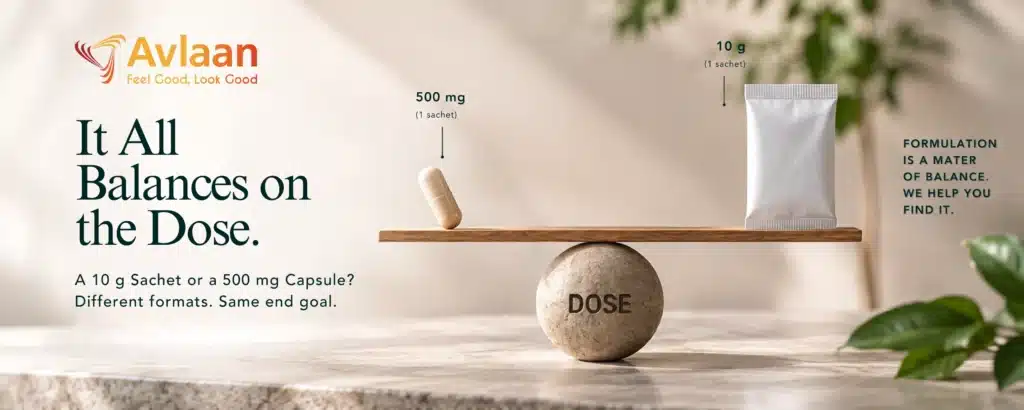
Most collagen product decisions in India are made in the wrong order. The format is chosen first – a 10 g sachet, because that is what the category looks like – and the ingredient is fitted to it afterwards. Talk to a vegan collagen ingredient supplier India early enough and the sequence reverses, because the dose determines the format, not the other way round.
The number that decides it is mass. Conventional hydrolysed collagen peptides are dosed in grams, commonly five to ten per day, which is why the category standardised on sachets and stick packs. A plant-origin amino acid complex is a different proposition entirely, and pretending otherwise leads brands to build a 10 g pack around a 1 g ingredient. It is the first thing worth establishing with any vegan collagen ingredient supplier India you shortlist.
This piece sets out the arithmetic a vegan collagen ingredient supplier India should walk you through before pack design starts: why peptides need grams, why free amino acids do not, what each format can physically carry, and how the economics change once you stop comparing price per kilogram.
Why Peptides Need Grams and Free Amino Acids Do Not
Hydrolysed animal collagen is a peptide. The body has to break it down into constituent amino acids before those amino acids become available for use, and a meaningful share of the ingested mass never reaches the target.
A plant-origin amino acid complex skips that step. Vollagen® supplies 18 amino acids already in isolated form, in the same proportions found in human collagen, produced by fermentation from non-GMO corn.
Because the amino acids are already isolated, the daily dose is 1,000 mg – not five to ten grams. That single fact reshapes every downstream decision about format, pack size, cost and consumer experience.
The formulation consequence in one line: A 1,000 mg daily dose fits comfortably into two capsules. A 5–10 g peptide dose does not fit into any capsule format at all. Ask any vegan collagen ingredient supplier India you shortlist for the daily dose in milligrams before you brief a packaging designer.
Reading the Amino Acid Profile Properly
The proportions matter more than the total. A collagen-ratio complex is defined by which amino acids dominate, and by the presence of two residues that generic amino blends do not contain.
Table 1: Principal amino acids in a 1,000 mg daily dose of a collagen-ratio complex (minimum levels)
| Amino acid | Per 1,000 mg dose | Why it is on the list |
|---|---|---|
| Glycine | 215 mg | The single most abundant residue in collagen structure |
| L-Proline | 128 mg | Core to the collagen triple-helix sequence |
| Hydroxyproline | 120 mg | A modified residue characteristic of collagen |
| L-Alanine | 95 mg | Third most abundant residue by mass |
| L-Glutamic acid | 95 mg | Significant structural contributor |
| L-Arginine | 75 mg | Present in the collagen sequence |
| Hydroxylysine | 5.2 mg | The second collagen-characteristic modified residue |
Hydroxyproline and hydroxylysine are the diagnostic pair. Their presence is what separates a collagen-ratio complex from an ordinary amino acid blend marketed as a collagen alternative.
It is a reasonable question for any buyer to put to a vegan collagen ingredient supplier India: ask for the full 18-amino-acid specification with minimum levels, not a marketing summary listing four of them.
What a Vegan Collagen Ingredient Supplier India Should Tell You About Format Capacity
Format selection is a physical constraint problem before it is a marketing one. The table below is the practical envelope.
Table 2: Format capacity and fit for a 1,000 mg daily dose
| Format | Practical payload | Fit for a 1 g dose | Trade-off |
|---|---|---|---|
| Size 0 capsule | ≈400–600 mg powder | Two capsules per day | Lowest cost pack; no taste issue |
| Tablet | ≈500–1,200 mg | One to two tablets | Needs excipients; disintegration testing |
| Stick pack | 2–15 g | Works, but mostly carrier | Pays for filler you do not need |
| Sachet | 5–30 g | Over-specified alone | Best used in a multi-ingredient blend |
| Functional beverage | Dose-dependent | Dissolves readily | Cold water-dispersible powder helps |
The stick pack row is where money leaks. If the active is 1 g and the pack is 5 g, four fifths of what the consumer pays to ship, store and open is carrier.
Where the Sachet Still Wins
None of this makes sachets wrong. It makes single-ingredient sachets wrong for this particular ingredient.
- Multi-ingredient beauty blends. When the collagen complex sits alongside biotin, vitamin C, zinc and a plant-origin Vitamin D3, the combined mass justifies the format.
- Beverage occasions. A cold water-dispersible powder in a drink is a genuinely different consumer ritual from swallowing a capsule, and it commands a different price.
- Consumers who will not take capsules. A real segment, and worth serving on its own terms.
- Flavour-led propositions. Where the taste experience is part of the product, not an obstacle to it.
The test is simple: if the sachet exists because the blend needs the volume, it is the right call. If it exists because the category looks that way, it is a cost you are choosing to carry.
Costing It Honestly: Rupees Per Day, Not Per Kilogram
Price per kilogram is the wrong comparator when the two options are dosed an order of magnitude apart.
A material dosed at 1 g per day delivers 1,000 servings per kilogram. A peptide dosed at 8 g per day delivers 125. Before any judgement about efficacy, that is an eightfold difference in servings from the same purchased mass.
Rebuild the comparison on cost per serving and cost per pack, then layer in packaging, filling and freight – which are all mass-driven. A significant portion of the apparent premium on a concentrated ingredient is recovered before the conversation reaches the consumer price.
What to Confirm Before You Commit to a Format
- The daily dose in milligrams, and the study or case-study basis for it.
- The full amino acid specification with minimum levels for all 18.
- Solubility and dispersibility behaviour in your intended matrix, at your intended temperature.
- Bulk density, so you can confirm the capsule size before tooling is committed.
- Taste and colour contribution at your inclusion rate.
- Documented plant origin and fermentation substrate for vegan endorsement purposes.
- What claim substantiation exists, and over what time period results were observed.
A capable vegan collagen ingredient supplier India can answer all seven from documentation. Case studies on a 1,000 mg daily dose have reported changes over a 60-day period, which is a useful anchor when you set consumer expectations on pack.
Key Takeaways
- Dose decides format. Establish the daily milligram dose before pack design begins.
- Hydrolysed peptides need grams because they must be broken down first; isolated amino acids do not.
- A collagen-ratio complex at 1,000 mg per day fits two capsules; a peptide dose fits no capsule.
- Hydroxyproline and hydroxylysine are the diagnostic residues – ask for all 18 with minimum levels.
- Sachets are right for multi-ingredient blends and beverages, not for a 1 g single active.
- Compare a vegan collagen ingredient supplier India on cost per serving, never on price per kilogram.
FAQs: Vegan Collagen Ingredient Supplier India: Dose and Format
1. How much vegan collagen is needed per daily serving?
A plant-origin amino acid complex supplying collagen-ratio amino acids is typically dosed at 1,000 mg per day. This is far lower than hydrolysed animal collagen peptides, which are commonly dosed at five to ten grams, because the amino acids are supplied already isolated rather than bound in a peptide that must first be broken down.
2. Can vegan collagen be delivered in capsules?
Yes. A 1,000 mg daily dose fits comfortably into two capsules, which is the lowest-cost format and avoids taste and solubility considerations entirely. This is not possible with gram-scale collagen peptides, which is why the animal-derived category standardised on sachets and stick packs.
3. Is a sachet format ever the right choice?
Yes, when the collagen complex sits inside a multi-ingredient blend whose combined mass justifies the pack, when the product is a beverage, or when the target consumer will not take capsules. The format becomes wasteful only when a 1 g active is carried in a 5 g pack of filler.
4. How do I verify that an amino acid complex genuinely matches collagen?
Request the full 18-amino-acid specification with minimum levels, and check for glycine as the dominant residue alongside proline, hydroxyproline and hydroxylysine. The two hydroxylated residues are characteristic of collagen and distinguish a collagen-ratio complex from a general amino acid blend.
5. Why is price per kilogram misleading for this ingredient?
Because the two options are dosed an order of magnitude apart. A 1 g daily dose yields 1,000 servings per kilogram against 125 for an 8 g peptide dose. Cost per serving, plus mass-driven packaging, filling and freight costs, gives a truer comparison.
6. How long before results are observed?
Case studies on a 1,000 mg daily dose have reported changes over a 60-day period. Use that as the basis for consumer expectation-setting on pack, and keep claim language within what FSSAI permits for nutraceutical products.
Choosing a Format for a Beauty-From-Within Launch?
Avlaan Pharmaceutical distributes Vollagen® in India – a 100% plant-origin amino acid complex matching the human collagen profile, produced by fermentation from non-GMO corn and supplied as a cold water-dispersible powder.
Our technical team supports dose and format selection, solubility trials and documentation for vegan endorsement as part of the supply relationship.
Request the full specification or a trial quantity:
Sree Krishna Leela, Unit 3, 1st Floor, New No. 34, 2nd Main Road, Raja Annamalaipuram, Chennai 600028
Phone: +91 735 855 1962 | Email: info@avlaanpharma.com | Web: www.avlaanpharma.com